Framework
A Framework for Strategic Industrial Transformation
Prepared for National and Regional Government Policy Leaders
By Thomas Morgan, WMG, University of Warwick
Contents
Pathfinder Application — UK Vehicle Electrification
Appendix B — Project Alchemy vision sketch
Executive Summary
N-SCAPE is a framework for the design, governance and delivery of strategic industrial ecosystems.
It provides commissioning authorities with a structured process for:
- Understanding industrial systems;
- Defining transformational ambitions;
- Coordinating ecosystem formation;
- Aligning policy and investment;
- Mobilising industrial capability;
- Delivering long-term strategic resilience.
Governments are increasingly adopting active industrial policy approaches focused on resilience, strategic capability and sovereign control over critical systems.
N-SCAPE is applicable to supply chain transformation at national or regional level across any sector. This paper uses UK vehicle electrification as a pathfinder application of the methodology.
Research undertaken through development of the framework identified four recurring structural barriers to successful government intervention in industrial ecosystem formation:
- Outcomes are not commercially competitive within global markets;
- Existing industrial vested interests resist system-level transformation;
- Discrete company activity fails where wider industrial ecosystem transformation is required;
- Fragmented, siloed policy interventions fail to deliver coordinated industrial transformation.
N-SCAPE addresses these structural failures through coordinated ecosystem architecture led by commissioning authorities. The framework consists of three stages:
- Landscape — understanding the current system, constraints and opportunity space;
- Transformation Vision — defining a strategic moonshot ambition;
- Supply Chain Architecture and Delivery — coordinating implementation, governance and ecosystem formation.
The framework positions governments and regional authorities as the coordinating actors responsible for long-term industrial transformation.
Glossary
Commissioning Authority — The government, regional authority or strategic institution responsible for initiating, funding and overseeing the application of N-SCAPE and its resulting ecosystem transformation.
Ecosystem — The interconnected network of industrial, commercial, policy, infrastructure and capability actors that collectively constitute a strategic supply chain.
Ecosystem Champion — The senior leadership authority responsible for driving transformation ambition across the ecosystem, maintaining strategic direction and overcoming institutional inertia.
Future-State — The target configuration of the ecosystem following successful transformation, as defined through the Transformation Vision stage.
Industrial Strategy — Government policy directed at shaping the structure, capability and competitiveness of national or regional industries over the long term.
Landscape — The first stage of N-SCAPE; a whole-system analysis of the current ecosystem’s structural, operational and strategic conditions.
Moonshot — An ambitious, long-term transformation target that goes beyond incremental improvement to define a fundamentally different future-state for the ecosystem.
N-SCAPE — National Supply Chain Architecture for Priority Ecosystems; a structured framework for the design, governance and delivery of strategic industrial ecosystems.
Project Alchemy — The N-SCAPE Pathfinder Application Transformation Vision – for a UK self-sufficient vehicle electrification ecosystem centred in the West Midlands.
Sovereign Capability — The ability of a nation to produce strategically critical goods or materials domestically, reducing dependency on foreign supply chains.
Supply Chain Architect — The independent team commissioned to lead the N-SCAPE stages, responsible for whole-system analysis, Transformation Vision and architecture design.
Supply Chain Architecture — The structured design of interconnected supply chain operations, transitions and relationships required to deliver ecosystem transformation.
Supply Chain Alliance — The coalition of commercial operations across the ecosystem brought together to function as an active ecosystem management team during delivery.
Transformation Vision — The second stage of N-SCAPE; a strategically positioned definition of the future-state ecosystem opportunity, ambition and parameters for transformation.
Valley of Death — The critical period between early-stage development and industrial-scale commercial deployment, during which many initiatives fail due to insufficient demand confidence or investment continuity.
1. Strategic Context
1.1 Industrial Transformation and Strategic Capability
Industrial strategy is increasingly shaped by:
- Geopolitics (competition, threats, events);
- Resource concentration;
- Energy transition;
- Technological competition;
- Supply chain vulnerability;
- National resilience requirements.
1.2 What Successful Industrial Transformation looks like
Successful industrial transformations share common characteristics:
- Commercial competitiveness within global markets;
- Industrial collaboration to achieve ecosystem goals;
- Centralised ecosystem leadership;
- Long-term enabling policy frameworks.
Examples include:
South Korea — global electronics leadership
- Government-directed industrial policy;
- Coordinated capital mobilisation;
- Development of national manufacturing capability through chaebol structures.
In 1969, the South Korean government declared electronics a national strategic industry. Over the following decade, the sector grew at an average of 46.6% per year[1]. By 2025, electronics exports exceeded $264 billion[2].
Taiwan — advanced semiconductor capability
- Government-backed creation of ITRI and TSMC;
- Long-term strategic investment;
- Industrial clustering and talent coordination.
In 1973, Taiwan’s government identified semiconductors as a strategic national priority, funding the research institute that became TSMC in 1987[3]. By 2025, TSMC held 61% of the global semiconductor foundry market, generating $122 billion in annual revenue[4].
China — solar PV, battery and EV scale-up
- Coordinated state investment across supply chains;
- Strategic procurement and industrial policy alignment;
- Long-term control of critical material systems.
China’s 2005 ‘Five-Year Plan’ formally designated solar PV, batteries and electric vehicles as strategic national industries[5]. By 2025, China controlled over 80% of global solar panel manufacturing, exported $67 billion worth of batteries, and its EV brands held nearly 70% of the global electric vehicle market[6].
Denmark — global wind energy leadership
- Early public investment in wind R&D;
- Stable long-term policy mechanisms;
- Industrial clustering and coordinated deployment.
In response to the 1973 oil crisis, Denmark launched state-backed wind research in 1978 and the birth of the modern wind power industry[7]. By 2025, Denmark supplied around 40% of the world’s wind energy technology exports[8].
Japan — post-war automotive and electronics expansion
- Government-led industrial planning;
- Coordinated industrial upgrading;
- Long-term capital and manufacturing alignment.
From 1949 the government (MITI) systematically directed investment, protected nascent industries and promoted exports in automotive and electronics — delivering GDP growth averaging 9% a year for three decades[9].
These examples demonstrate that successful industrial transformation is fundamentally an ecosystem architecture challenge.
1.3 Industrial Transformation as Ecosystem Architecture
Industrial transformation requires coordinated transition across interconnected supply chain operations.
As ecosystems evolve:
- Existing operations may be retained, transformed or phased out;
- New operational capabilities may need to be established;
- Supply and demand conditions may evolve at different rates;
- Transitional operating models may be required before full ecosystem capability is achieved.
Effective ecosystem architecture coordinates these transitions across the entire supply chain to enable, de-risk and accelerate industrial transformation.
2. The N-SCAPE Framework
2.1 Framework Purpose
N-SCAPE provides a repeatable architecture framework for strategic industrial transformation.
It enables commissioning authorities to:
- Understand current industrial conditions;
- Identify structural constraints;
- Define transformational ambitions;
- Coordinate ecosystem development;
- Align policy and investment;
- Deliver long-term industrial capability.
The framework is intended for use by:
- National governments;
- Regional authorities;
- Industrial development agencies;
- Strategic infrastructure bodies;
- Economic transformation programmes.
2.2 Framework Logic
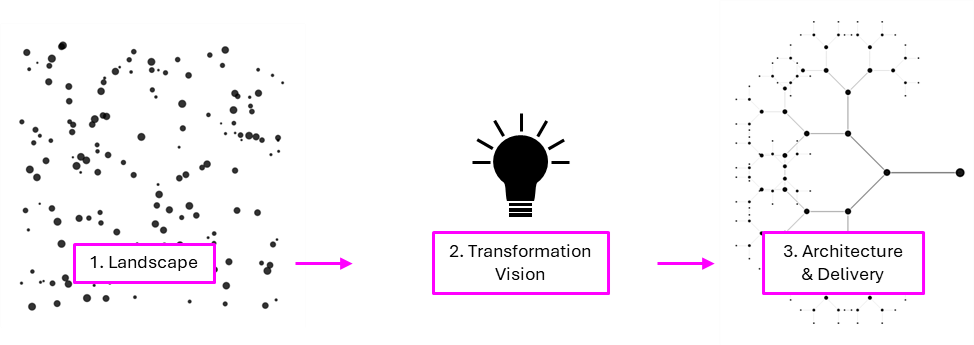
The framework is intentionally structured in three stages:
- Landscape;
- Transformation Vision;
- Supply Chain Architecture and Delivery.
This sequence is deliberate.
Industrial transformation frequently fails because:
- Ambitions are defined before structural conditions are understood;
- Delivery mechanisms are fragmented;
- Existing industrial actors optimise for incumbent advantage rather than system transformation;
- Governments attempt to coordinate transformation through consultation rather than architecture.
N-SCAPE reverses this process by:
- Establishing a whole-system understanding first;
- Developing a coherent Transformation Vision second;
- Coordinating ecosystem delivery third.
2.3 Framework Delivery
The three stages of N-SCAPE should be led by a commissioned Supply Chain Architect — typically an independent team whose freedom from existing institutional relationships and commercial interests ensures the analysis and solution are objective and evidence-based.
3. Stage 1 — Landscape
3.1 Purpose
The Landscape stage establishes a whole-system understanding of the current ecosystem.
The purpose is to establish the structural, operational and strategic conditions required to define a credible transformation ambition – not to validate pre-existing assumptions.
Landscape sets out the evidence base required before transformation ambition is defined.
3.2 Impact
Landscape establishes:
- Structural conditions and constraints;
- Operational effectiveness and competitiveness;
- Supply chain vulnerabilities and dependencies;
- Capability gaps and transition requirements;
- Strategic opportunities and positioning.
Landscape also challenges assumptions around:
- Existing industrial structures;
- Market competitiveness;
- Supply chain resilience;
- Long-term ecosystem viability.
The Landscape stage ensures that transformation ambition is grounded in operational and strategic reality rather than isolated market activity or incumbent assumptions.
3.3 How
Landscape includes:
- Demand mapping — identifying and quantifying current and future market demand for the sector’s products or services, by geography, segment and application.
- Supply mapping — cataloguing existing suppliers, production capacity and input dependencies across the value chain to reveal concentration risks and gaps.
- Operational process mapping — documenting the end-to-end processes to identify inefficiencies, bottlenecks and opportunities for improvement.
- Capability assessment — evaluating the skills, technologies, IP and organisational capacity available domestically against what the sector requires to compete.
- Infrastructure analysis — assessing the physical and digital infrastructure — energy, transport, connectivity, facilities — that underpins or constrains sector performance.
- Policy mapping — reviewing the regulatory, legislative and incentive landscape that shapes how the sector operates, invests and grows.
- Geopolitical exposure assessment — examining the sector’s vulnerability to trade restrictions, supply chain disruptions, sanctions or shifting international alliances.
- Competitiveness assessment — benchmarking the sector’s cost base, quality, innovation and market position against international rivals to determine where advantages and gaps lie.
4. Stage 2 — Transformation Vision
4.1 Purpose
The Transformation Vision stage establishes a clear strategic opportunity, ambition and future-state positioning for the ecosystem.
The purpose is to define a credible Transformation Vision in direct relation to the structural conditions identified through the Landscape stage.
Transformation Vision does not solve the transformation challenge. It sets the future-state ambition and defines the parameters for system transformation architecture.
4.2 Impact
Transformation Vision establishes:
- The future-state opportunity;
- Its relationship to the current ecosystem;
- The scale and complexity of transition required.
Transformation Vision enables commissioning authorities to:
- Align stakeholders around a shared transformation ambition;
- Coordinate policy, procurement, investment and support mechanisms;
- Prioritise industrial, infrastructure and capability interventions;
- Establish long-term strategic direction and leadership.
4.3 How
The architect draws upon the intelligence established through the Landscape stage to define a strategically positioned future-state ecosystem opportunity.
The vision positions the opportunity relative to:
- Current industrial conditions, inertia and barriers;
- Market dynamics;
- Macro forces;
- Policy and legislative direction;
- Supply chain structures;
- Long-term transformation timelines.
A well-formed vision is more than a statement of ambition — it clearly defines each of the six ecosystem attributes, describing what success looks like across production, ownership, capability, infrastructure and investment conditions.
5. Stage 3 — Supply Chain Architecture and Delivery
5.1 Purpose
The final stage translates the Transformation Vision into coordinated system transformation architecture and delivery.
5.2 Impact
This stage establishes the structures and mechanisms to coordinate the transition from current‑state to future‑state ambition across the supply chain.
This delivers:
- Coordinated transition and investment planning for individual supply chain operations;
- Long-term demand visibility and investment confidence across interconnected ecosystem activities;
- Synchronised timing of supply, demand and operational scale-up across dependent industrial capabilities;
- Alignment of commercial relationships and operational transition through Supply Chain Alliance structures;
- Coordinated progression of ecosystem operations through the “valley of death” to industrial-scale deployment.
5.3 How
N-SCAPE positions commissioning authorities as the coordinating entities responsible for long-term ecosystem transformation.
Critical activities include the appointment of an Ecosystem Champion, establishment of a Supply Chain Architecture team and formation of a Supply Chain Alliance.
The Ecosystem Champion is responsible for driving the transformation ambition across the ecosystem by providing the leadership authority, strategic influence and institutional momentum required to:
- Secure long-term stakeholder alignment;
- Maintain transformation focus and direction;
- Drive commitment across interconnected authorities and delivery bodies;
- Align engagement across government, industry and institutions;
- Overcome institutional inertia and fragmented decision-making.
The Supply Chain Architecture team develops the individual operation transition plans from whole-system analysis, operational flow optimisation and systems modelling. These are delivered through the Supply Chain Alliance.
The Supply Chain Alliance brings together ecosystem participants to coordinate commercial alignment, operational transition and shared ecosystem delivery – an “ecosystem management team”.
6. Pathfinder Application — UK Vehicle Electrification
6.1 Summary
N-SCAPE has been applied to the UK vehicle electrification ecosystem.
This Pathfinder Application identified major industrial, operational and policy coordination challenges across UK electric vehicle manufacturing and supply chains.
Despite these structural constraints, the whole-system landscape mapping also revealed the conditions for a strategically significant industrial opportunity.
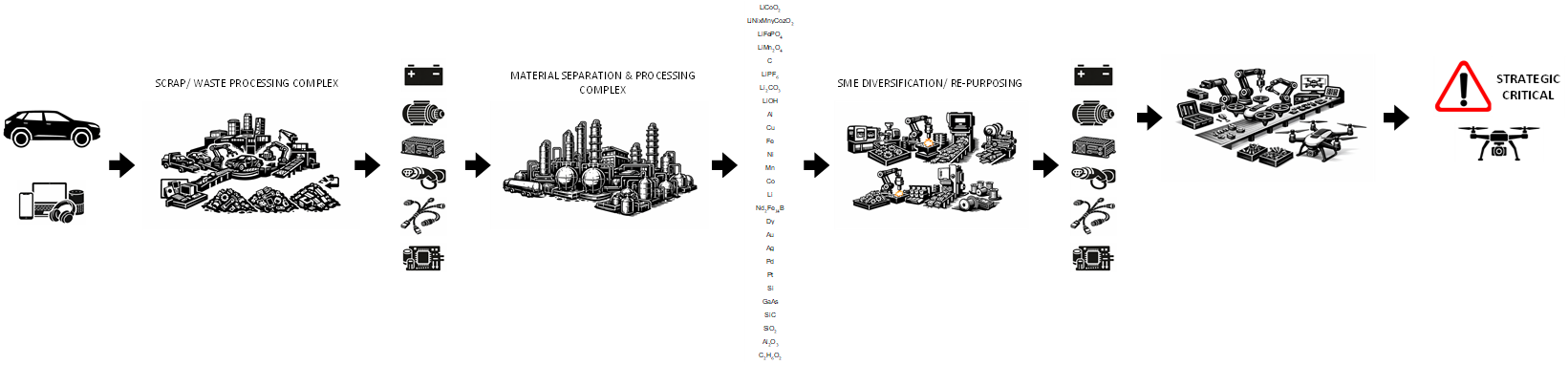
Through the Transformation Vision stage, this opportunity was developed into a moonshot ambition for a UK self-sufficient electrification ecosystem centred in the West Midlands — grounded in strategic procurement, material recovery from waste and coordinated industrial investment. This is Project Alchemy.
The result is a comprehensive and strategically positioned industrial transformation model against which the West Midlands — as the region best placed to lead delivery — can consider, adopt and commission the final stage of supply chain architecture and delivery.
6.2 Landscape Findings
The Landscape stage examined the UK vehicle electrification ecosystem across:
- OEM demand;
- System supply;
- Upstream processing capability;
- Material recovery;
- Policy and investment environments.
6.2.1 Market Context
The analysis identified a structurally fragmented ecosystem:
- OEM activity within the UK operates primarily as part of global manufacturing footprint strategies rather than as a consequence of a competitive domestic industrial ecosystem;
- Existing tier-one systems suppliers are not drawing on domestic component suppliers;
- Specialist and niche supply chain capability remains low-volume and fragmented;
- Significant activity is sustained through research and collaborative programmes rather than industrial-scale deployment;
- Critical upstream processing capability is absent;
- Large volumes of strategic materials are exported as waste.
6.2.2 Policy Context
The Landscape identified strong national policy alignment, led by The UK’s Modern Industrial Strategy 2025[10], around:
- Supply chain resilience;
- Sovereign capability;
- Domestic supply;
- Industrial competitiveness;
- Critical material security.
The analysis identified substantial public funding deployed through research, innovation and early-stage commercialisation programmes.
However, this funding is structured around discrete projects and is not scoped to support:
- Supply chain formation;
- Industrial-scale deployment;
- Ecosystem transformation;
- Long-term operational integration.
This reveals a disconnect between the direction and intent of policy and the mechanisms in place to deliver that intent.
The result is development leadership, which builds reputation, rather than retained industrialisation, which builds the economy.
6.3 Transformation Vision — Project Alchemy
Drawing on the understanding established through the Landscape stage, a Transformation Vision was developed for a UK self-sufficient electrification ecosystem based on:
- Domestic material recovery as a strategic resource base;
- Regional industrial concentration in the West Midlands;
- Specialist electrification capability rather than mass-market competition;
- Resilience and sovereign capability rather than lowest-cost global production.
6.3.1 Anchor Demand
Section 1 identifies commercial competitiveness within global markets as a critical success factor for successful industrial transformation.
Project Alchemy addresses this challenge by anchoring initial demand within defence applications where supply chain resilience, security and sovereign capability are prioritised over lowest-cost global production.
Defence provides the long-term demand confidence required to support investment, industrial capability development and operational scale-up through the “valley of death” to commercially viable industrial deployment.
This demand signal extends across interconnected supply chain activities — from material recovery and processing through to component and systems manufacture.
6.3.2 Anchor Supply
The Landscape identified significant geopolitical vulnerability across critical material supply chains, consistent with the priorities established in Resilience for the Future: The UK’s Critical Minerals Strategy (2025), alongside the continued export of strategic materials as waste — previously estimated by DEFRA at more than £5bn per year[11].
Projection of end-of-life material volumes from electronics, electric vehicles and wind turbines indicates the emergence of substantial domestic material recovery and reprocessing potential through the 2030s.
Project Alchemy proposes to exploit this material stream through the establishment of industrial-scale material recovery and reprocessing capability to supply a diversified and re-industrialised domestic electrification manufacturing base.
6.3.3 Anchor Location
The West Midlands was identified as the leading regional location for ecosystem concentration.
The region has established critical structural capital: central logistics positioning; significant electrification capability across OEMs, suppliers and academia; significant material recovery R&D activity across operators and academia; and a large industrial and manufacturing base requiring diversification.
Further, the region already has the industrial, circular economy and investment policies required to support the proposed ecosystem transformation[12].
It is important to note that this anchoring establishes capability and capacity at scale. The individual commercial activities are then positioned to compete within wider civilian and open-market supply chains.
Appendix B shows the Project Alchemy Vision sketch.
7. Rationale
7.1 Government as Coordinating Authority
N-SCAPE is based on the principle that strategic industrial transformation requires active government coordination and long-term institutional commitment.
The framework recognises that ecosystem transformation does not emerge automatically from fragmented market activity, isolated company interventions or disconnected policy mechanisms.
N-SCAPE therefore positions governments and regional authorities not simply as facilitators of growth, but as coordinating authorities responsible for long-term ecosystem outcomes including:
- Economic resilience;
- Industrial competitiveness;
- Employment;
- Productivity;
- Sovereign capability;
- Value creation.
This requires authorities to:
- Define strategic transformation direction;
- Coordinate investment and infrastructure;
- Align policy and procurement mechanisms;
- Commission long-term ecosystem architecture and delivery.
7.2 Industrial Leadership and System Transformation
The framework recognises that industrial actors typically optimise for existing commercial structures, firm-level priorities and short-term operational advantage.
As a result:
- Existing system conditions are frequently reinforced;
- Transformation activity remains fragmented;
- Long-term ecosystem outcomes remain secondary to individual commercial interests;
- Public investment and support fails to achieve projected impact
N-SCAPE therefore positions industrial consultation as an input into transformation delivery rather than the mechanism through which transformation strategy is defined.
The framework instead prioritises:
- Strategic architecture;
- Long-term ecosystem positioning;
- Coordinated transformation;
- Ecosystem-level outcomes.
8. Applying N-SCAPE
8.1 Who N-SCAPE is for
N-SCAPE is intended to be commissioned by governments, regional authorities and strategic institutions seeking to coordinate long-term industrial transformation.
The framework is designed for challenges where:
- Supply chains are fragmented;
- Industrial capability is incomplete;
- Strategic dependency exists;
- Existing policy and investment mechanisms are not compounding into ecosystem formation.
The framework positions the commissioning authority as the long-term coordinating entity responsible for ecosystem outcomes.
8.2 What N-SCAPE can be applied to
N-SCAPE can be applied to support national, regional and sector policies to establish strategically positioned transformation opportunities grounded in real industrial conditions, market dynamics and long-term ecosystem requirements.
The framework enables commissioning authorities to:
- Define credible long-term industrial ambitions;
- Position transformation opportunities relative to structural realities;
- Coordinate policy, procurement and investment mechanisms;
- Align stakeholders around ecosystem-level outcomes;
- Establish the basis for coordinated system transformation architecture and delivery.
Appendix A provides an illustrative mapping of potential UK N-SCAPE industrial transformation opportunities categorised as critical, strategic and other, including indicative regional leadership positioning.
8.3 How to apply N-SCAPE
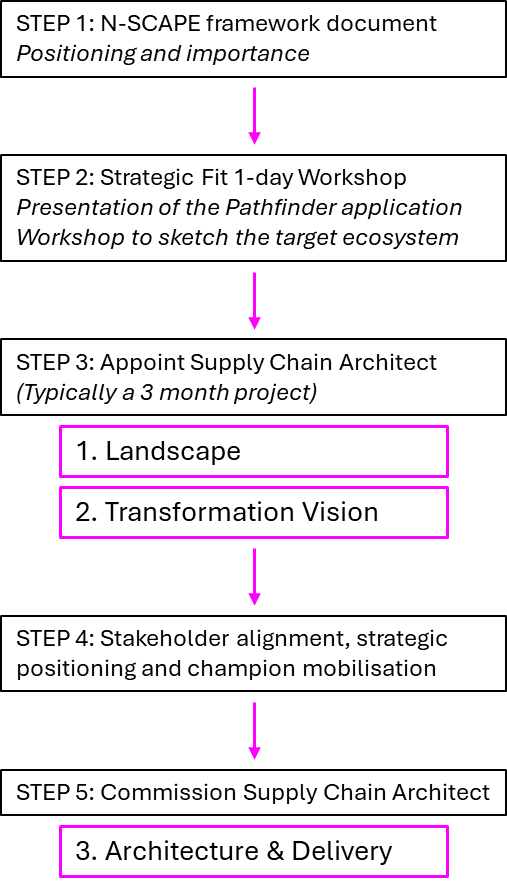
Application of N-SCAPE begins with an introductory strategic workshop for commissioning authority teams.
The workshop introduces the framework through discussion of the UK Pathfinder Application, followed by a live mapping exercise on the selected industrial challenge, sketching existing assumptions and perceptions.
This confirms strategic fit and, as an eye‑opener, makes clear why the next critical step is appointing a Supply Chain Architect to lead the Landscape and Transformation Vision stages.
Together, these require approximately three months.
With the Transformation Vision in place, responsibility then passes to the commissioning authority to take ownership of the Vision and drive stakeholder buy‑in, led by an appointed Champion. Once sufficient alignment is secured, the commissioning authority is able to commission the Supply Chain Architect to lead full delivery.
Commissioning Authority pathway
9. Conclusion
Strategic industrial transformation is increasingly defined by resilience, sovereign capability, supply chain security and long-term industrial competitiveness.
However, industrial transformation does not emerge automatically from fragmented market activity, isolated company interventions or disconnected policy mechanisms.
N-SCAPE provides a structured framework through which commissioning authorities can understand industrial ecosystems, define strategically positioned transformation ambitions and coordinate long-term ecosystem formation.
The UK vehicle electrification Pathfinder Application demonstrates how whole-system Landscape analysis combined with a strategically positioned Transformation Vision can identify nationally significant industrial transformation opportunities grounded in real industrial conditions and long-term transition requirements.
Adoption of the framework positions governments and regional authorities not simply as facilitators of growth, but as coordinating entities responsible for driving long-term industrial transformation and ecosystem outcomes including competitiveness, productivity, resilience and retained industrial capability.
Contact
Thomas Morgan, Supply Chain Architect
thomas@n-scape.studio
Acknowledgements
The development of N-SCAPE and the UK vehicle electrification Pathfinder Application benefited from strategic discussion, challenge and contribution from industry, academia and regional institutions.
Particular thanks are extended to Gun Gokmen for supply chain analysis support and Gareth Thomas for strategic advisory input during development of the framework and Pathfinder Application.
The West Midlands Combined Authority provided strategic engagement and feedback on the Pathfinder Application and the positioning of this document.
References
Amsden A.H.(1989) The Korean Miracle (1962–1980) Revisited, Kellogg Institute Working Paper 166 ↑
Ministry of Trade, Industry and Energy (MOTIE) (2025)ICT Export–Import Trends 2025 ↑
Industrial Technology Research Institute (ITRI) (2024) History of ITRI and the Founding of TSMC ↑
Taiwan Semiconductor Manufacturing Company (TSMC) (2025) Annual Report 2025 ↑
National Development and Reform Commission (NDRC) (2005) 11th Five‑Year Plan for National Economic and Social Development ↑
Ministry of Industry and Information Technology (MIIT) (2025) China New Energy Vehicle and Advanced Manufacturing Statistical Communiqué 2025 ↑
Danish Energy Agency (DEA) (1978) Energy Research Programme 1978: Wind Turbine Development ↑
Danish Energy Agency (DEA) (2025) Danish Wind Industry Export Statistics 2025 ↑
MITI (1980) White Paper on International Trade and Industry ↑
Including The UK’s Modern Industrial Strategy (2025), Resilience for the Future: The UK’s Critical Minerals Strategy (2025), the UK National Security Strategy and related resilience and industrial policy frameworks ↑
DEFRA, Resource Management: A Catalyst for Growth and Productivity, 2015 ↑
Including the WMCA Growth Plan, West Midlands Circular Economy Routemap, WMCA Net Zero 2041 Strategy and West Midlands Innovation Accelerator programme ↑
Department for Environment, Food & Rural Affairs (2015) Resource Management: A Catalyst for Growth and Productivity. London: DEFRA
HM Government (2025) National Security Strategy
HM Government (2025) Resilience for the Future: The UK’s Critical Minerals Strategy
HM Government (2025) The UK’s Modern Industrial Strategy
Innovate UK/ West Midlands Combined Authority (2023–2025) West Midlands Innovation Accelerator
West Midlands Combined Authority (2021) WMCA Net Zero 2041 Strategy
West Midlands Combined Authority (2021, updated 2024) West Midlands Circular Economy Routemap
West Midlands Combined Authority (2025) WMCA Growth Plan
Appendix B — Project Alchemy vision sketch
An indicative high-level ecosystem architecture illustration for Project Alchemy, demonstrating the relationship between strategic material recovery, upstream processing, industrial diversification and downstream systems manufacture within a coordinated electrification supply ecosystem…